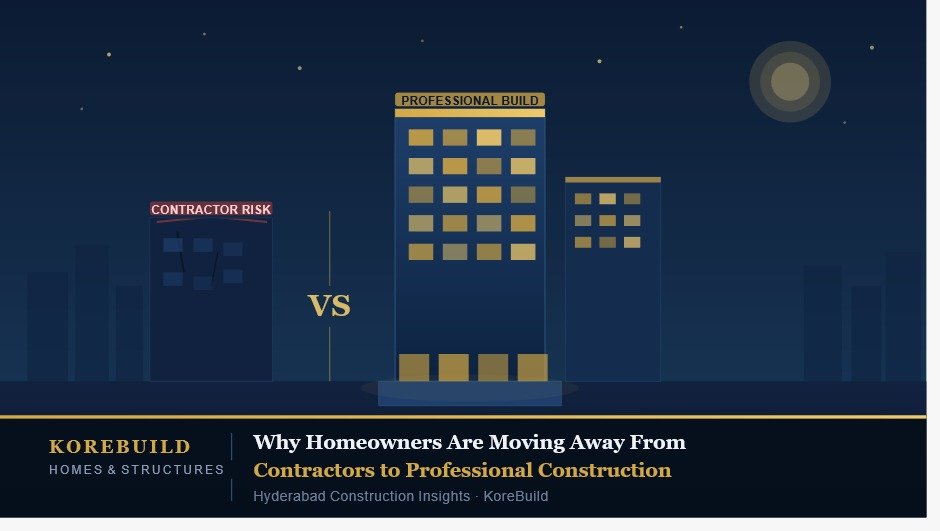
Why Homeowners in Hyderabad Are Choosing Professional Construction Companies Over Local Contractors
Category: Construction Insights | Published by: KoreBuild Homes & Structures | Location: Hyderabad, Telangana
Building a home is likely the single largest financial decision of your life. Yet for decades, most families in Hyderabad — and across India — have handed over that decision to a local contractor, often found through a friend's referral and accepted with a quiet warning: "Talk to him yourself. We're not responsible for anything."
That warning deserves more attention than it usually gets.
Today, a growing number of homeowners are choosing to work with professional construction companies instead. This shift is not just about money — it is about accountability, quality, peace of mind, and ultimately, protecting one of the most important investments a family will ever make.
Here is an honest look at why this change is happening, and what it means for you.
The Contractor Model: How It Works — and Why It Often Fails
The Referral Chain
In India, the traditional approach to construction begins with a phone call to a relative or neighbour. Someone knows a contractor. They pass on his number, often with a caveat: "He built my cousin's house. But keep a close eye on everything yourself."
This has been the default for generations. The problem is that the system has not changed — even as expectations for construction quality, compliance, and transparency have risen considerably.
What a Typical Contractor Actually Offers
Most local contractors operate as solo or very small teams. They do not employ qualified structural engineers. They do not have in-house architects, project managers, procurement teams, or quality inspectors. Their overhead is minimal — which is exactly how they justify lower quotes.
What this means in practice:
- No structural engineering rigour. Work proceeds on habit and assumptions, not engineered drawings. This places the structural integrity of your home at real risk.
- No accountability for timelines. Without a team dependent on project completion, a contractor has little financial motivation to finish on time. The moment he secures another project elsewhere, yours moves to the back of the queue.
- No cost transparency. The initial quote rarely captures the full picture. Hidden costs, scope-creep, and mid-project revisions are standard operating procedure — not exceptions.
- No quality benchmarks. When you raise a concern about workmanship, the typical response is: "This is how it's done." There is rarely a documented quality standard against which work can be measured.
The Dispute Problem
The statistics here are sobering: a significant majority of construction contracts with individual contractors end in disputes. The root cause is almost always the same — the project was never properly planned. Cost, sequencing, quality parameters, and timelines were based on rough assumptions from the start. When reality diverges from those assumptions — and it always does — the contractor's easiest exit is to ask for additional payment or simply walk away from the site.
At that point, you are left with an incomplete structure, disbursed funds, and very little legal recourse.
The Hidden Costs Nobody Talks About
Financial Surprises
Contractors rarely explain — upfront — what is and is not included in their quote. Buyers are routinely surprised by charges for items they assumed were part of the scope. This is not always deliberate dishonesty; it often reflects the fact that the contractor himself has not costed the project thoroughly before signing up for it.
A professional construction company, by contrast, provides a clearly defined project cost estimate, a payment milestone schedule, and a scope document before a single brick is laid. You know what you are paying, and when.
The Attention Problem
A contractor typically handles two or three projects simultaneously. He is the project manager, site supervisor, material procurer, and quality inspector — all rolled into one person. The moment a larger or more lucrative project comes up, your site gets less attention. Timelines slip. Materials are not checked. Quality steps are missed.
This is not malice. It is the natural consequence of a one-person operation stretched too thin.
What a Professional Construction Company Changes
A Full Team, Not a Single Person
When you engage a professional construction company, you are not hiring one individual — you are accessing an entire team. Architects, structural consultants, MEP engineers, project managers, procurement managers, estimation engineers, and on-site supervisors all contribute to your project.
This means:
- Your architectural design accounts for vastu, functionality, natural light, and future expansion.
- Your structural design is calculated and verified by a qualified engineer, not arrived at by gut feel.
- Your MEP (mechanical, electrical, and plumbing) systems are planned from the start — not retrofitted at the end when walls are already finished.
- Your materials are procured with checks on quality and quantity, reducing wastage and substandard substitutions.
Accountability Built Into the Model
A construction company has something a contractor does not: financial skin in the game. If a project is delayed, the company incurs real costs — salary overheads, equipment costs, opportunity costs. This creates a genuine internal incentive to deliver on time. Compare this to a contractor, for whom your delayed project simply means he keeps his options open elsewhere.
When you assign a project to a company, the responsibility does not rest on one person's conscience. It rests on a structured organisation with defined processes, documented checkpoints, and named accountable roles.
Defined Payment Schedules
A professional construction company operates on milestone-linked payment schedules. You release funds when specific, verifiable stages of construction are completed — not when the contractor decides he needs money. This protects your cash flow, creates natural checkpoints for quality review, and eliminates the anxiety of wondering when the next unplanned demand will arrive.
Documented Quality Standards
Construction quality should never be a matter of opinion. It should be measured against defined standards — IS codes, NBC guidelines, and project-specific specifications. A professional company maintains documented quality checklists at every stage: foundation, sump, structural frame, brickwork, plaster, waterproofing, electrical, finishing.
If something does not meet the standard, it is identified and rectified before the next stage begins. There is no "this is how we always do it" — there are written benchmarks that every member of the site team works to.
A Note on Companies That Simply Outsource to Contractors
This is an important distinction worth making clearly.
Some firms market themselves as professional construction companies but, in practice, hand your entire project to an onboarded contractor — just with a design layer added on top. They take a commission of 5–7% of project value and manage the drawings. The actual construction is executed by the same type of contractor you were trying to avoid.
Design accounts for roughly 5% of what makes or breaks a construction project. The remaining 95% — site execution, material quality, structural integrity, finishing work — is where the real difference lies. If that 95% is being managed by an unaccountable contractor, the professional company label offers you very little protection.
When evaluating a construction company, always ask: Who is actually on site? Who employs the engineers? Who is responsible when something goes wrong during construction, not just during design? Is there a named, accountable person behind the company?
What You Are Really Paying For
If you have never experienced the stress of a contractor relationship gone wrong, it can be tempting to optimise for the lowest possible price. That is understandable. But those who have lived through a contractor dispute — the missed calls, the half-finished work, the midnight anxiety about whether a quality step was completed or skipped — will tell you that the price difference barely registers against the cost of that experience.
The premium you pay to work with a structured construction company covers:
- Engineers who are present on site, not just available by phone
- Quality inspections at every stage, documented and signed off
- A single point of contact who can answer every question — from structural load calculations to tile selections
- A payment structure that aligns with progress, not with someone else's cash flow needs
- And fundamentally: the ability to sleep through the night without worrying about your building
That is not a small thing. It is the difference between a construction experience that adds to your family's future, and one that costs far more than just money.
About KoreBuild Homes & Structures
KoreBuild Homes & Structures is a Hyderabad-based professional construction company serving residential and commercial projects across areas including Isnapur, Tellapur, Narsingi, and HMDA-approved zones.
The company is led by an alumnus of ISB (Indian School of Business) and a qualified Chartered Accountant — professionals who bring rigour in financial planning, project governance, and quality management to every project they handle. Their team of experienced architects, structural consultants, MEP engineers, and trusted vendors ensures that each home and structure is built intelligently, on time, and to a standard worth standing behind.
If you are planning to build in Hyderabad and want a process-driven, transparent, and accountable construction partner — KoreBuild is built for exactly that.
📞 Contact us: korebuild.in | amit@korebuild.in
📞 Call : 9988005653